
When a micron makes the difference
At first glance, a wire is a line.
Straight. Thin. Seemingly simple.
But in advanced wire applications, wire plating is where reality begins.
It is at the surface that electrons move, heat is transferred, and friction, corrosion, or signal loss first appear. When wire dimensions shrink to microns, the surface is no longer a detail — it becomes the system.
What Is Wire Plating — And Why It Matters
Wire plating is often described as a thin layer of metal added to a base material. In reality, wire plating is a critical engineering method used to control electrical, thermal, mechanical, and chemical performance in demanding applications.
In medical devices, aerospace systems, and high-reliability electronics, even the smallest deviation at the surface level can affect the entire product solution.
A signal degrades.
A joint fails prematurely.
A component behaves differently after thousands — or millions — of cycles.
This is why wire plating exists.
Not as decoration.
But as engineering.
Wire Plating as a Tool to Engineer Critical Properties
The right plating solution is more than a thin metallic layer. It is a way to engineer critical properties with precision, especially in ultra-fine tungsten and molybdenum wires.
Advanced wire plating enables the optimization of:
- Electrical conductivity and signal stability, where noise and loss are unacceptable
- Thermal conductivity, supporting heat transfer in compact systems
- Solderability, ensuring reliable and repeatable joints
- Surface finish and friction characteristics, crucial in moving, woven, or contacting components
- Corrosion resistance, even in aggressive or high-radiation environments
- Biocompatibility, essential for medical wire applications
- Lifetime performance, where long-term stability is as important as initial function
At this scale, wire plating does not simply enhance a wire — it defines how it behaves.
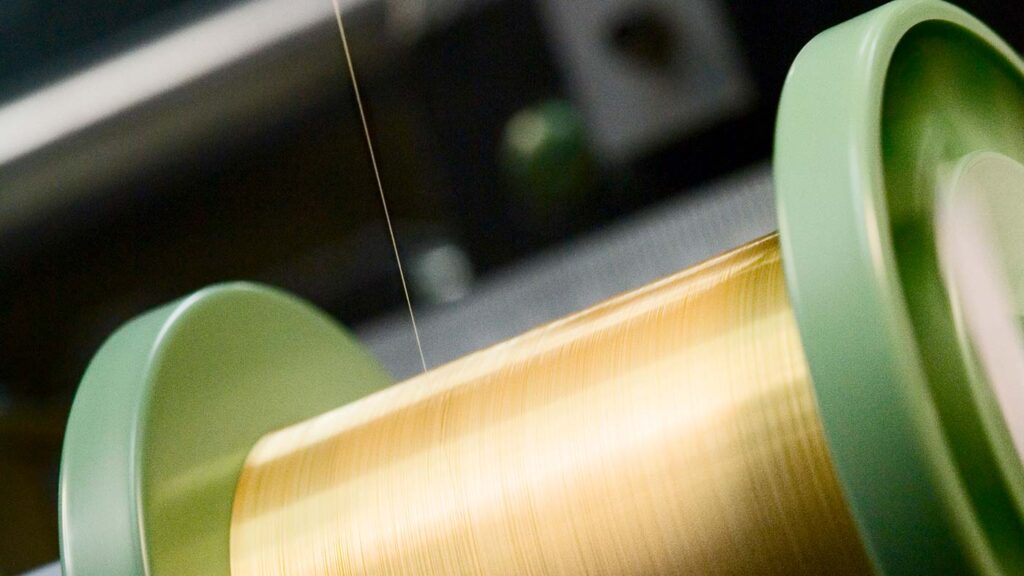
Gold Wire Plating for Ultra-Fine Tungsten and Molybdenum Wires
Base materials such as tungsten and molybdenum are selected for strength, density, and thermal stability. However, few materials offer all required properties on their own.
This is where plating becomes essential.
By combining a robust, lower-cost core material with a high-performance surface coating, wire plating makes it possible to achieve properties that would otherwise conflict:
- Mechanical strength and high electrical conductivity
- Thermal stability and corrosion resistance
- Durability and controlled surface interaction
As a result, gold-plated tungsten wire and gold-plated molybdenum wire are widely used in applications where reliability, signal integrity, and long-term performance are non-negotiable.
Each layer has a role.
Together, they create a material system neither could achieve alone.
Wire Plating for Medical, Aerospace, and Electronic Applications
In medical applications, plating ensures corrosion resistance, controlled surface chemistry, and biocompatibility. What touches the human body must behave exactly as intended — every time.
In space and aerospace applications, plated fine wires must withstand extreme thermal cycling, radiation exposure, vibration, and long mission lifetimes without degradation.
In electronics and semiconductor applications, plating supports stable electrical contact, reliable soldering, and consistent signal transmission as components continue to shrink.
Across these industries, plating is not about appearance. It is about trust.
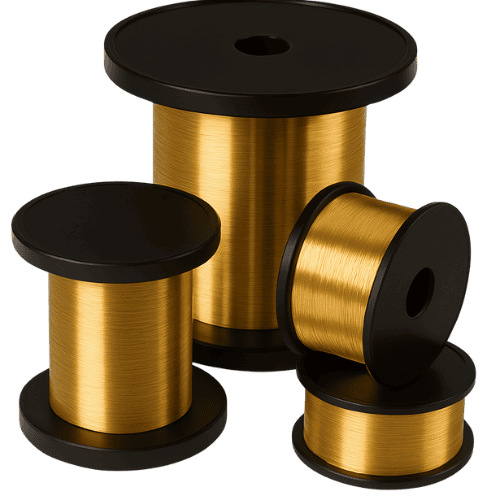
Lifetime Performance Starts with Wire Plating
Lifetime performance is not assumed. It is engineered.
It begins at the surface — where materials interact with their environment, with other components, and sometimes with the human body.
Resistance to oxidation.
Stable electrical behavior over time.
Predictable mechanical interaction.
All of these characteristics are defined by the quality, consistency, and adhesion of the plated layer.
Where Luma Wire Tech Applies Wire Plating Expertise
At Luma Wire Tech, plating is treated as a technical discipline, not a final process step.
Working with ultra-fine wires, down to just a few microns, requires precise control of plating thickness, adhesion, porosity, and surface morphology. At this scale, “almost right” is not enough.
Plating must follow the wire perfectly.
Every contour. Every micron. Every meter.
Because this is where performance is decided.
Why Wire Plating?
Because endurance is engineered.
Because performance lives at the surface.
Because the smallest layer often carries the greatest responsibility.
Advanced plating makes it possible to create wires that:
- Endure more
- Last longer
- Perform better
Even where other materials fail.
FAQ – Wire Plating
Why is wire plating important in advanced applications?
Wire plating allows precise control of conductivity, corrosion resistance, solderability, and long-term performance in demanding environments.
Why is gold wire plating used on tungsten and molybdenum?
Gold wire plating improves electrical conductivity, corrosion resistance, and surface stability while protecting the core material.
How does wire plating affect lifetime performance?
High-quality wire plating ensures stable electrical behavior, resistance to oxidation, and predictable surface interaction over time.
How can we help you choosing the right wires for your application?