Imagine you are part of an R&D team developing medical devices – anything from catheters, stents, guidewires and needles to sensors, instruments and robotic surgery systems. Fine wire for medical devices may be one of the smallest components you work with, but as you are about to find out, it can create some surprisingly big challenges.
One of the products in your portfolio has been in production for several years. At the heart of it is a fine wire that was once groundbreaking for its application. It still works. The materials are proven and the manufacturing process is well established. But nothing lasts forever. Not even cold November rain, as Axl Rose sang what feels like a lifetime ago.
New MDR requirements, combined with fierce competition, have forced you to put other projects aside and prioritise an update of the product. There is a reputation to protect – not to mention those impressive sales figures.
The base wire currently used in the product is not the problem. It already provides the mechanical properties you need. Replacing it would mean going back through testing and qualification, potentially followed by years of validation. Time you simply do not have if you want to remain competitive. The surface of the wire, however, is another matter.
It could be improved to meet the new requirements: better electrical contact performance, enhanced biocompatibility, improved conductivity or a surface that works better with the next step in the manufacturing process – potentially making production more efficient as well. Whatever the reason, you would much rather improve the wire you already use than start searching for an entirely new one.
A few years ago, your options might have been limited. Today, you could send that wire to us.
Keep the wire. Change the surface.
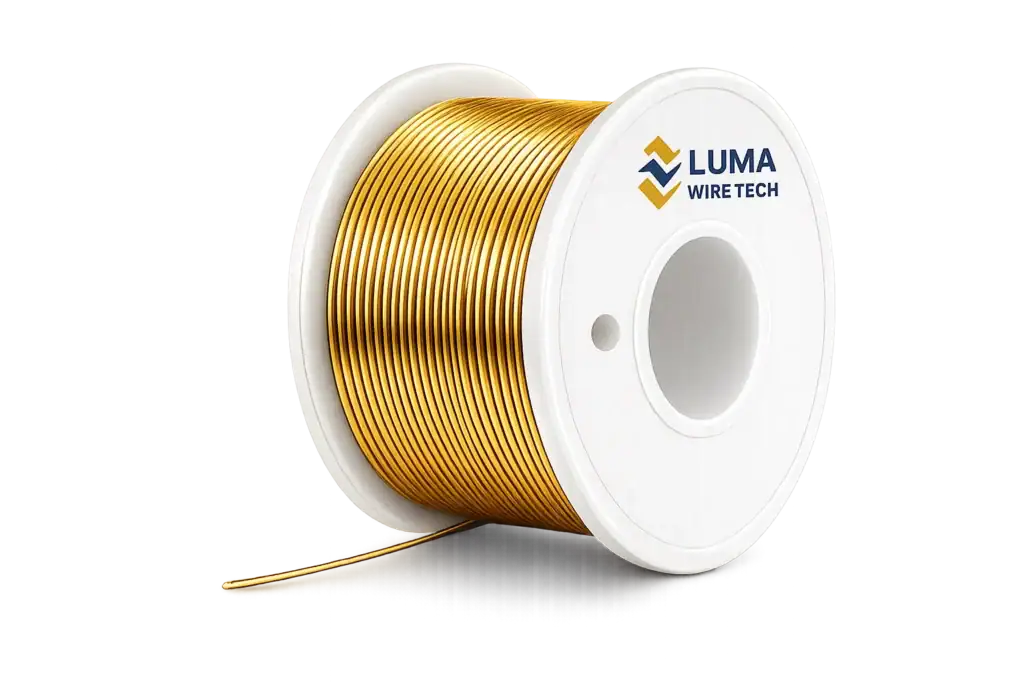
With Luma Plating Services, customers can send their own fine wire to our facility in Sweden for reel-to-reel plating.
Depending on the wire and application, we can plate fine wires from 5 to 200 µm with gold, silver, copper, palladium, platinum, tin, nickel or rhodium.
For the product developer you have already become acquainted with, this opens up an interesting route forward. instead of replacing a proven base material, it may be possible to give the existing wire new surface properties. The core remains the material already selected for the application, while the surface can be developed around what the next generation of the product needs. It is not always the answer, of course. But it is certainly an option worth investigating before redesigning the component from scratch.
And while that project is moving forward, another assignment lands on our product developer’s desk.
This time, there is no existing wire.
Now we start with a blank sheet of paper
The second project is a completely new medical device.
There is a target diameter and an initial idea of what the wire needs to do, but the material has not yet been decided. That makes this a very different discussion from the first project.
Perhaps high strength at an extremely small diameter is critical. Perhaps electrical conductivity matters more. There may be requirements related to movement, temperature, subsequent manufacturing processes or the environment in which the finished component will operate.
Ten years ago, a conversation with Luma would probably have started with tungsten or molybdenum. Today, there are considerably more directions to explore.
Our fine wire portfolio now includes tungsten, molybdenum, tungsten-rhenium, stainless steel, titanium, copper, silver and iron, together with selected specialty alloys, in dimensions from 4 to 200 µm, depending on material and application.
Instead of starting the conversation with a specific material, we can start with the application.
What does the wire actually need to do? What does it need to withstand, deliver and perform?
From there, we can look together at which base material provides the best starting point. But there is another decision to make: the properties and performance of the surface.
The best core material may not have the best surface
This is where our two projects suddenly start to have something in common.
Whether we are improving an existing medical device or developing a completely new one, the core of the wire and its surface do not necessarily need to solve the same problem.
The new product may need the mechanical properties of one material but the surface properties of another. With our reel-to-reel plating capabilities, those properties can be combined.
A base material can be selected for its mechanical properties and then plated to add the characteristics required at the surface. Depending on the application, that could mean gold, silver, copper, palladium, platinum, tin, nickel or rhodium.
For our product developer, the number of possible routes forward has suddenly become considerably larger.
Instead of searching for one material that ticks every box, the development team can look at the core material and the surface as two parts of the same design decision.
And sometimes that combination turns out to be more interesting than either material on its own.
Two projects. Two very different starting points.
At the end of the week, there are still two wire challenges sitting on our product developer’s desk.
For the existing product, the question is:
Can we improve the surface without replacing a wire that already works?
For the new product:
Which combination of material, dimension and surface gives us the properties we need?
They are two very different development projects.
But today, Luma Wire Tech can be part of both.
Our roots are still firmly in the ultra-fine tungsten and molybdenum wire we have worked with for more than 90 years. What has changed is the toolbox around that expertise.
More base materials. More plating options. And the ability to apply our plating expertise to wire supplied by our customers.
That gives us considerably more ways to approach a medical wire challenge – whether the starting point is a proven wire that needs to become even better, or a completely new device where the right wire has yet to be defined.
If either of these projects sounds familiar, send us your drawing, your specification or a sample of the wire you are already using.
We can start from there.
How can we help you choosing the right wires for your application?