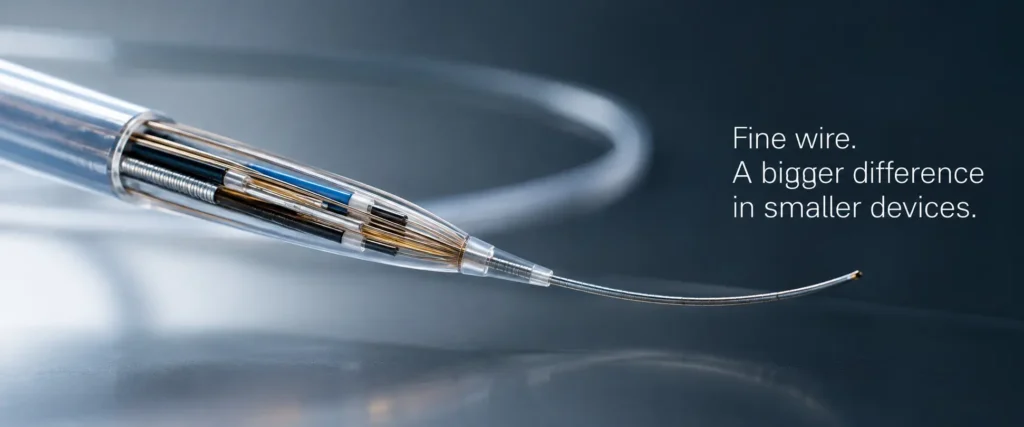
Inside a catheter, space is limited. Extremely limited.
At the same time, catheter-based medical devices are becoming increasingly advanced. Depending on the application, they may need to support sensing, measurement, navigation, signal transmission, energy delivery or feedback – sometimes several of these functions within the same device.
Every additional function needs space.
For an R&D engineer working on the next generation of a catheter-based device, this creates a familiar challenge: how do you add functionality when there is very little room left to work with?
This is where fine wire for catheters can become an important part of the design. Components measured in micrometers can help create space for additional functionality, but reducing wire diameter also introduces new electrical, mechanical and material considerations.
How fine wire can support catheter miniaturization
Fine metallic wire may represent only a small part of the complete catheter design, but its diameter can become important when several components have to share a very limited cross-sectional area.
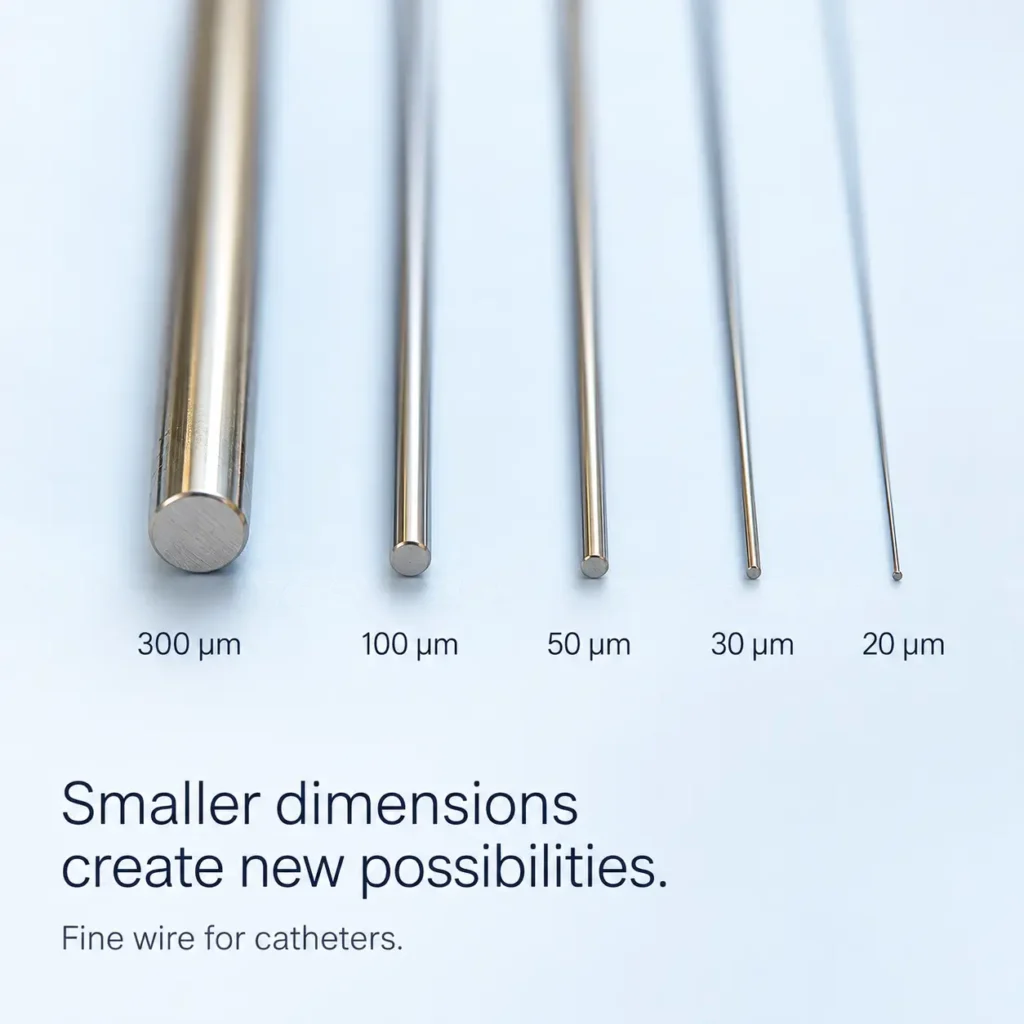
Reducing a conductor from 50 µm to 30 µm, or from 30 µm to 20 µm, may create additional space for another conductor, sensor connection or other functionality. In some designs, reducing the dimensions of internal components may also contribute to reducing the overall dimensions of the device.
This is one reason why fine wire for catheters becomes increasingly relevant as catheter-based devices become smaller while incorporating more functionality.
But going thinner is not simply a matter of specifying a smaller diameter on a drawing. As the wire diameter decreases, its electrical and mechanical behaviour changes as well.
What happens when the wire diameter decreases?
Electrical resistance is one obvious consideration. Reducing the diameter reduces the cross-sectional area of the conductor, which increases resistance if the material and length remain the same.
Mechanical properties and handling also become increasingly important. Depending on the application, the wire may need a specific combination of strength, ductility or flexibility while still being manufactured and handled reliably at very small dimensions.
Tolerances also become increasingly important as dimensions decrease. A variation of only a few micrometers represents a much larger proportion of the total diameter of a 20 µm wire than it does on a considerably thicker wire.
This means that a material that works well in one diameter is not automatically the best solution when the wire becomes significantly thinner.
The question therefore shouldn’t only be:
How thin can the wire be?
It should also be:
What does the wire need to do at that diameter?
Choosing fine wire materials for catheters
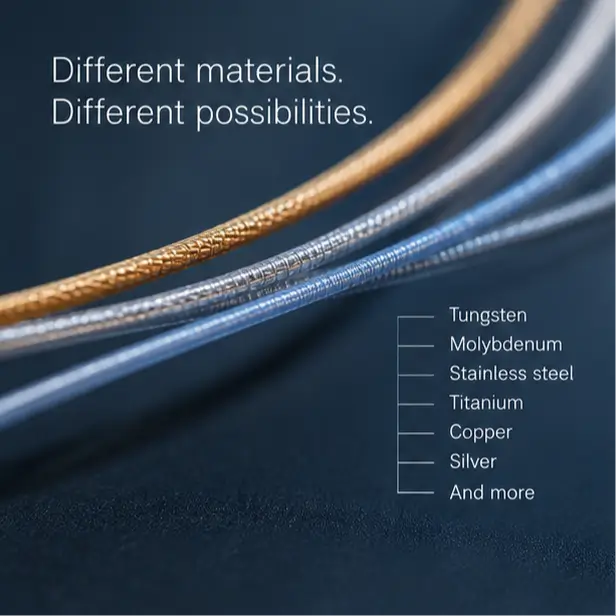
Material selection is an important part of developing fine wire for catheters, because different materials provide very different combinations of electrical, mechanical and surface properties.
At Luma Wire Tech, we work with fine wire in materials including tungsten, molybdenum, stainless steel, titanium, copper and silver, as well as specialty alloys.
For one catheter application, electrical resistance may be an important factor. In another, mechanical strength, ductility or flexibility may play a larger role. Corrosion behaviour, surface properties, operating environment and compatibility with subsequent manufacturing processes can also influence the choice.
This is why material selection needs to start with the function of the wire in the finished catheter rather than with a preferred material.
And the base material is only part of that discussion.
Plated fine wire for catheter applications
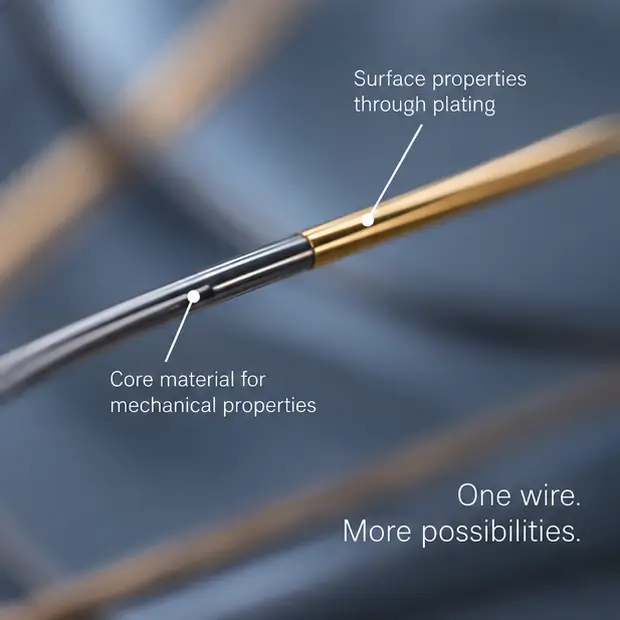
The properties required from the surface of a fine wire are not necessarily the same as those required from its core.
A base material may provide the mechanical or electrical properties needed for the application, while a metallic coating can provide different properties at the surface.
Depending on the requirements, fine wire can be plated with gold, silver, copper, palladium, platinum, nickel, tin or rhodium. The coating can be selected to modify properties such as electrical conductivity, corrosion resistance, solderability, electrical contact performance or wear resistance.
The plating process also needs to be adapted to the base material and the requirements of the application. Surface preparation, coating thickness, uniformity and adhesion all become part of the final wire specification.
This gives catheter developers another option when selecting materials. Instead of looking for one material that provides every required property, the core material can be selected for one set of characteristics and the surface for another.
Can an existing catheter wire be plated?
Not every development project needs to start with a new base wire.
If a specific wire material has already been evaluated or selected for a catheter application, it may make more sense to keep that material and investigate whether its surface can be modified to provide additional properties.
At Luma Wire Tech, we can work both with wire manufactured by us and with customer-supplied fine wire for reel-to-reel plating.
This can be particularly interesting in development projects where the base material has already been selected or tested, but additional surface properties are required.
It also gives R&D teams the possibility to evaluate different surface solutions without necessarily changing the underlying wire material at the same time.
From catheters to other medical device applications
The challenge of fitting more functionality into less space is not unique to catheters.
Many of the engineering considerations involved in selecting fine wire for catheters are also relevant to guidewires, sensors, electrodes, needles, surgical instruments and other medical devices where small dimensions need to be combined with specific electrical, mechanical or surface properties.
The requirements can vary significantly from one application to another. This is why there is no single material, diameter or coating that can be described as the best solution for every medical application.
The right solution depends on what the wire needs to do.
Start with the catheter application, not the wire
When space becomes limited, reducing wire diameter can open up new possibilities. But the smallest possible wire is not necessarily the best wire.
Electrical performance, mechanical properties, base material, surface condition and possible coatings all need to work together with the requirements of the finished catheter.
That is why our discussions with catheter and medical device developers usually start with the application.
What will the wire be used for? Which properties are critical? What environment will it operate in? Which dimensions are available? And what does the surface need to do?
Only after understanding those requirements does it make sense to discuss material, diameter and surface treatment.
Because in catheter development, making something smaller is one challenge.
Making it smaller without compromising what it needs to do is another.