
When new performance requirements arise, changing the wire material may seem like the obvious solution. But for a wire that has already been tested, qualified and integrated into production, a material change can mean new validation, additional development work and increased risk.
Fine wire surface engineering offers another possibility: changing the surface instead of the wire.

Add the Properties You Need Through Fine Wire Surface Engineering
The base material and the surface do not necessarily have to solve the same problem.
A wire may already provide the right mechanical properties, dimensions and processability for an application. Through electroplating, additional properties can be introduced at the surface while retaining the characteristics of the underlying wire.
Depending on the coating material and application, surface engineering can improve properties such as:
- Electrical and thermal conductivity
- Electrical contact performance
- Corrosion resistance
- Wear resistance
- Solderability
- EMI shielding performance
- Biocompatibility
- Performance in extreme temperatures
- Long-term surface stability
Gold, silver, palladium, platinum, rhodium, nickel, copper and tin all bring different properties to a wire.
Silver, for example, offers outstanding electrical and thermal conductivity, while gold combines excellent corrosion resistance with stable electrical contact performance. Tin is widely used to improve solderability, while rhodium provides exceptional wear resistance. Nickel can be used both as a functional coating and as an intermediate layer to improve adhesion and coating stability.
The challenge is therefore not simply choosing a plating material. It is finding the right combination of base wire material, surface preparation, coating material and coating thickness for the requirements of the application.
Build on an Already Proven Wire
This approach becomes particularly interesting when the wire is already established in production.
Companies often invest considerable time and resources in qualifying materials, approving suppliers and optimizing manufacturing processes. Replacing an existing wire can have consequences far beyond the material itself.
Fine wire surface engineering provides an opportunity to build on what is already working.
With Luma Fine Wire Plating Services, customers can send us their existing wire for plating. This allows them to maintain an established wire supplier and continue using a proven base material while gaining access to new surface properties and advanced electroplating expertise.
Depending on the application, this can help improve product performance, increase reliability and extend product lifetime while reducing the qualification risk associated with changing the underlying wire material.
For new product developments, the possibilities are even broader. The base material and coating can be considered together from the beginning, allowing engineers to combine properties from different materials instead of expecting one material to provide everything.
Fine Wire Surface Engineering Requires Fine Wire Expertise
Electroplating a fine wire is not simply a matter of applying a metallic layer.
As wire dimensions decrease, wire handling, surface preparation, coating uniformity and process control become increasingly important. The performance of the finished wire depends on how the base material, surface preparation, coating material, coating thickness and operating environment work together.
This is where Luma’s experience makes a difference.
For decades, Luma Wire Tech has worked with ultra-fine wire and demanding applications where dimensions, surface quality and consistency are critical. That expertise is at the core of our approach to fine wire surface engineering.
Our objective is not simply to coat the wire, but to understand what the surface needs to achieve in the final application.
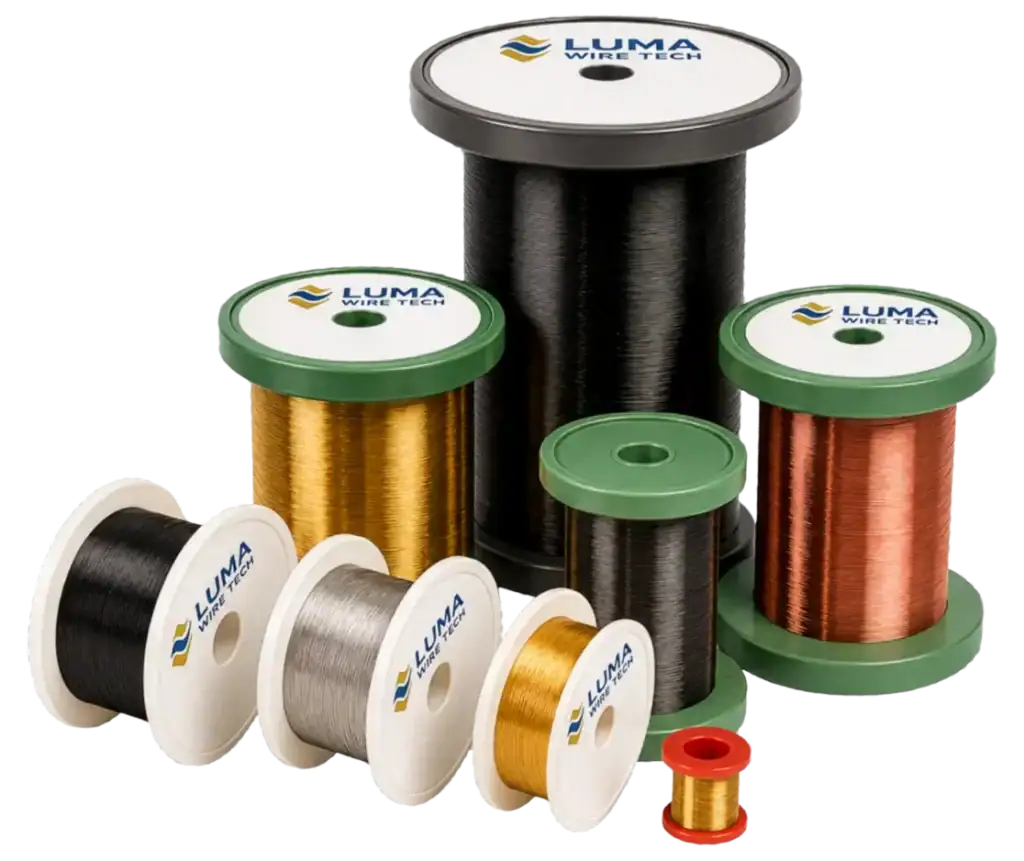
Reel-to-Reel Electroplating at Luma Wire Tech
Luma specializes in reel-to-reel electroplating of ultra-fine wire dimensions from 5 to 200 µm.
During reel-to-reel processing, the wire moves continuously from spool to spool through a controlled plating process. This enables consistent coating quality and efficient processing of fine wire over continuous lengths.
Our plating materials include:
We work with customer-supplied wire as well as Luma wire materials, giving customers the flexibility to retain existing supply chains or develop completely new wire and coating combinations.
The appropriate solution depends on the application. Coating thickness, substrate material, operating environment and required properties all influence the final performance.
That is why our technical team works together with customers to identify and develop the right plating solution rather than approaching fine wire surface engineering as a standard, one-size-fits-all process.
What Could the Right Surface Add to Your Wire?
Sometimes a different wire material is the right answer.
In other cases, the wire already provides exactly the properties the application needs – except at the surface.
By combining a proven base material with carefully engineered plating, it is possible to add functionality, improve performance and create new opportunities without necessarily changing the wire itself.
That is what Luma Fine Wire Plating Services is about.
Explore our plating capabilities, compare available coating materials and discover what the right surface could add to your wire.
How can we help you choosing the right wires for your application?

