
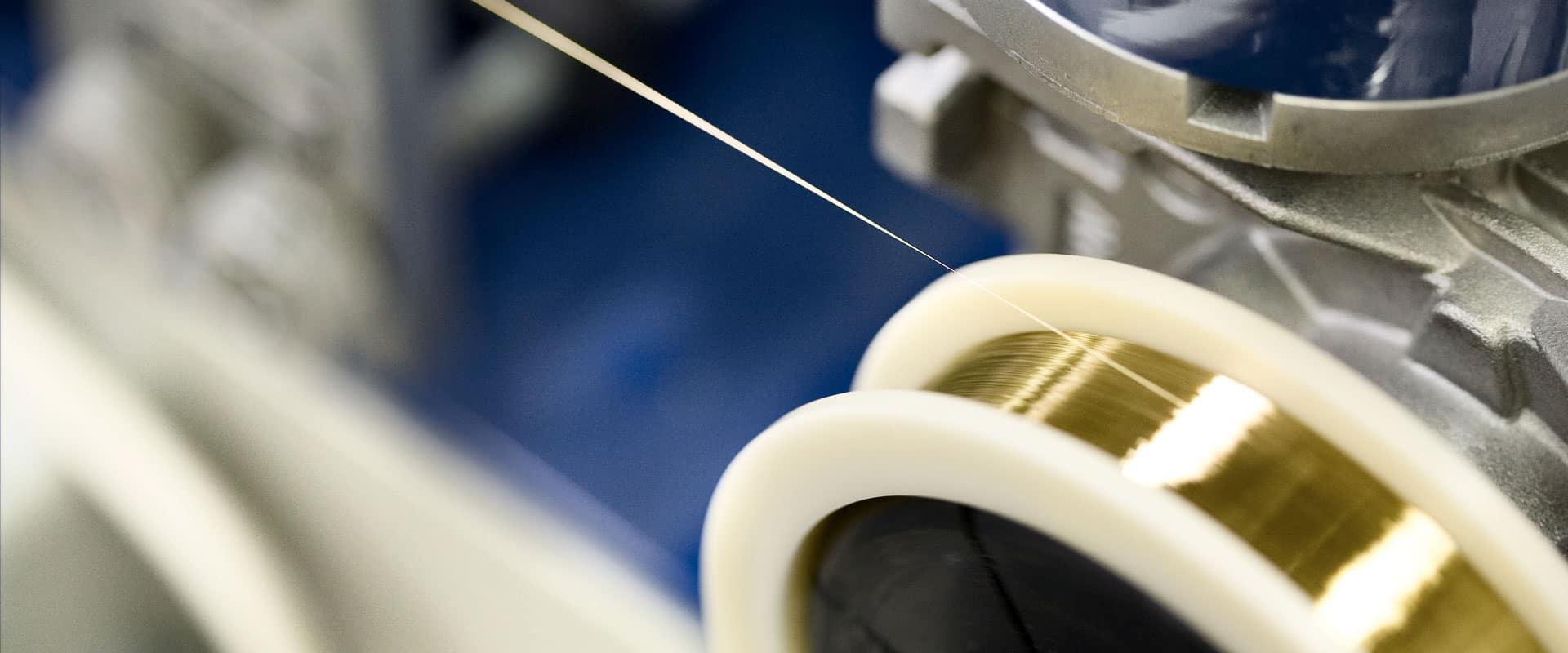
When engineers discuss wire performance, the conversation often revolves around the base material. Tungsten, molybdenum, stainless steel, copper, or silver. And rightly so. The base wire provides the foundation. But in many demanding applications, fine wire plating is what transforms a good wire into an exceptional one. The true difference in performance often lies in the few microns that form the wire’s outermost layer.
Why Fine Wire Plating Matters
At first glance, a fine wire looks deceptively simple.
A thin strand of metal, often no thicker than a human hair. Yet behind that simplicity lies an impressive amount of engineering.
The base material determines many of the wire’s fundamental properties. Strength, flexibility, conductivity, temperature resistance, and durability all begin there. But once the wire leaves the production floor and enters its intended environment, it faces an entirely new set of challenges.
- Electrical currents must flow reliably.
- Corrosive environments must be resisted.
- Mechanical wear must be endured.
- Signals must remain stable.
- Performance must remain consistent, often for years.
This is where fine wire plating begins to reveal its true value.
The Ship and the Ocean
Imagine a ship crossing the Atlantic.
The steel hull provides the strength required to withstand waves, storms, and countless miles at sea. Yet without a protective outer layer, the relentless saltwater would eventually begin to attack the very structure that keeps the ship afloat.
The strength is in the steel. The protection is in the surface. This principle is well known across countless industries where corrosion protection and surface engineering play a critical role in product performance and lifetime. Fine wire behaves in much the same way.
The base material provides the foundation, but the surface is what meets the outside world. It is the surface that carries the electrical contact, resists corrosion, endures wear, and interacts with surrounding materials.
In many applications, the wire’s performance is ultimately defined by those few microns between the base material and its environment.
Small Layer. Big Difference.
Fine wire plating is not simply about changing the appearance of a wire. It is about tailoring how the wire interacts with its environment. By modifying the outermost surface, engineers can enhance conductivity, improve corrosion resistance, increase wear performance, or add entirely new functionality without changing the underlying wire material.
A gold-plated wire can improve corrosion resistance, ensure stable electrical contact, and provide radiopacity in medical applications.
A silver-plated wire can significantly enhance electrical conductivity.
A palladium coating can improve wear resistance and long-term contact performance.
A platinum coating can provide exceptional stability in highly demanding environments.
The underlying wire may remain exactly the same, yet its capabilities can change dramatically.
It is a bit like fitting different tyres to the same vehicle. The engine, chassis, and drivetrain remain unchanged, but the performance can be transformed depending on the road ahead.
Your Wire. Our Expertise.
Upgrade your fine wire with advanced reel-to-reel plating and surface engineering.
Engineering at the Micron Level
As products become smaller, lighter, and more advanced, the demands placed on fine wire continue to increase.
Medical devices require reliability in critical procedures.
Electronics demand stable signal transmission and conductivity.
Sensors operate in increasingly challenging environments.
Space and aerospace applications leave little room for compromise.
In these applications, performance is often determined by details invisible to the naked eye.
A few microns of the right coating can improve functionality, extend service life, reduce failure risks, and unlock entirely new possibilities for an existing wire design.
Looking Beyond the Base Material
When selecting a fine wire, it is natural to focus on the base material first. But the question engineers increasingly ask is not only What should the wire be made of?
It is also:
What should the surface do?
Should it conduct better?
Resist corrosion?
Improve wear resistance?
Enhance solderability?
Provide better electrical contact performance?
The answer often lies in the coating.
Discover What a Few Microns Can Do
At Luma Wire Tech, our reel-to-reel fine wire plating service helps customers tailor the performance of fine wires without changing the underlying wire design.
Through precision fine wire plating, engineers can enhance conductivity, corrosion resistance, wear resistance, and functionality while retaining the proven properties of the base material.